Insights • September 24, 2026
If AI Can Do Entry-Level Work, Where Do Fresh Graduates Start?
If AI can perform the tasks beginners used to do to gain experience, the first rungs of the career ladder are changing. Here is where fresh graduates can start.
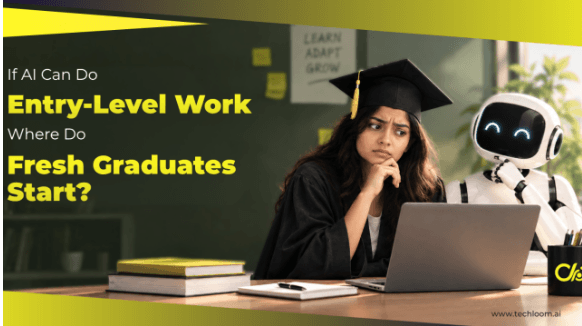
For years, the advice given to fresh graduates was relatively straightforward:
Get a degree.
Build a resume.
Apply for internships.
Start with an entry-level job.
Learn from senior employees.
Make mistakes.
Gradually take on more responsibility.
This was the ladder to success.
However, what happens when the first few steps of that ladder begin to disappear?
Artificial intelligence can now write emails, summarize reports, generate and debug code, analyze data, create designs, conduct research, and automate repetitive business tasks. Increasingly, newer AI systems are moving beyond individual tasks and into multi-step computer workflows. They can browse the internet, use various software applications, manipulate information, and carry out parts of professional processes with minimal human direction.
GPT-6 Astra, OpenAI’s latest frontier model, is an example of how quickly these capabilities are advancing. OpenAI claims that Astra represents a significant increase in functionality, including enhancements in cybersecurity, and is designed to handle increasingly complex tasks and workflows.
The rapid improvement of this technology has led companies to invest heavily in it, changing how organizations approach work. Simultaneously, technology companies around the world are restructuring their workforces. Some are cutting jobs while significantly increasing their spending on AI infrastructure. Others are altering their expectations for new hires. Researchers are starting to observe that younger workers in occupations heavily influenced by AI may be experiencing weaker employment outcomes.
This development broadens the conversation about AI and employment beyond the question we’ve been asking for years:
Will AI take our jobs?
Now, a more pressing question emerges:
If AI can perform the tasks that beginners traditionally carried out to gain experience, where do fresh graduates start?
Perhaps an even larger question follows:
As the nature of work evolves, how do we all learn to live and work alongside this technology?
This is no longer just a story about a specific industry; it is becoming a story that impacts everyone.
The Entry-Level Job Has Always Served Two Purposes
First, there is productivity. Companies hire junior employees to complete necessary tasks.
Second, there is training. Graduates often start by preparing reports, testing software, researching competitors, answering customer inquiries, cleaning data, writing basic content, or creating presentations. While these tasks may not seem significant, they provide valuable learning experiences.
You gain insights into how a company operates, learn to communicate effectively with managers, encounter customer interactions, understand what happens when problems arise, and make decisions when instructions are unclear. Over time, these small responsibilities translate into experience. Experience leads to greater responsibilities, and greater responsibility leads to seniority. This progression forms the traditional career ladder.
However, the rise of AI is beginning to disrupt this ladder’s economics. If AI systems can perform a significant amount of routine work in a matter of minutes, companies may feel less inclined to assign this work to beginners solely for training purposes.
This does not mean that every entry-level position will vanish, but it could indicate that some tasks usually designated for training inexperienced employees may become automated, condensed, or integrated into the duties of more experienced staff. Early signs suggest that this shift may already be occurring, and the clearest evidence for it isn’t showing up in layoff numbers at all.
The First Sign May Not Be Layoffs
One of the most significant recent studies comes from Stanford’s Digital Economy Lab. In a research update from August 2026, based on payroll data from ADP, researchers Erik Brynjolfsson, Bharat Chandar, and Ruyu Chen found no evidence of widespread job displacement caused by AI across the economy. However, they discovered something more specific.
The employment gap for workers aged 22 to 25 in occupations highly exposed to AI had widened to approximately 19% compared to similarly aged workers in less-exposed occupations, according to the researchers’ analysis.
The first sign of AI disruption may not be layoffs or employees being replaced. It may be that companies simply stop hiring for certain entry-level roles in the first place. Work that would once have been assigned to a junior employee may now be handled by AI tools and a smaller team. Over time, this can reduce the number of entry-level opportunities available, making it harder for graduates to get their first foothold in the job market.
A graduate who never secures their first job doesn’t gain the experience needed for subsequent opportunities. Someone must first gain experience before they can become seasoned in their field.
The layoffs represent only a visible part of a larger trend within the technology industry. Companies are restructuring their teams, reducing headcount, and redirecting substantial amounts of capital toward artificial intelligence (AI).
A recent example is Oracle. In September 2026, Oracle announced an additional $700 million in restructuring costs, raising its projected fiscal 2026 restructuring costs to approximately $2.8 billion. This restructuring includes job cuts and contract terminations, while the company continues to invest heavily in AI infrastructure. According to Reuters, Oracle is also raising significant capital to fund its expansion.
It’s important to note that not every job cut at Oracle can be attributed to AI. Corporate restructuring involves multiple causes. However, the contrast is striking: there is more investment in machines and infrastructure, but less investment in certain forms of human labor.
Oracle is not an isolated case. Across the technology industry, companies are restructuring while simultaneously investing in AI, automation, and computing infrastructure. Layoffs may be the most visible aspect of this transformation, but they are not the only one.
The more subtle changes often happen quietly. For example, a company may stop advertising for junior roles, leaving vacancies unfilled. An experienced employee might use AI tools to manage tasks that were previously divided among several employees. Some work that once served as a starting point for graduates may simply be absorbed into existing roles, meaning companies no longer need to create a separate position for it. A graduate may apply for a role expecting to compete with other applicants, only to find that the company has decided not to hire for that position at all.
None of these changes appear dramatic when viewed as statistics on layoffs. However, collectively, they can significantly alter how individuals enter the workforce. That instability sits directly beneath a bigger debate now playing out among the industry’s own leaders: how fast is too fast?
What Anthropic’s CEO Is Warning About
On September 12, 2026, Dario Amodei, CEO of Anthropic, published an essay titled “We Must Pace the Frontier,” arguing that the AI industry should deliberately slow how fast it improves model capabilities. His concern isn’t just that AI is advancing quickly. It’s that OpenAI, Anthropic, Google DeepMind, and Meta are locked in a race where slowing down individually just lets a competitor take the lead. Every lab might prefer a safer, more coordinated pace, but none wants to be the first to fall behind.
Amodei isn’t calling for a halt. He wants time for safety testing and independent oversight to catch up with capability, especially as AI increasingly helps build the next generation of AI itself. Citing recent incidents involving AI agents and cybersecurity, he proposes three steps:
Embedded third-party evaluation: Independent safety evaluators would have significant access to frontier AI companies and their systems to ensure safety standards are met.
Coordination among democratic countries and AI companies: This would prevent companies from feeling pressured to choose between prioritizing safety or allowing competitors to advance unchecked.
Global coordination: Recognizing that AI development is not confined to a single company or country is essential for effective oversight.
Not everyone agrees. Meta CEO Mark Zuckerberg has argued that individual companies should be responsible for managing the risks of AI rather than relying on a coordinated industry-wide slowdown.
The underlying dynamic matters for graduates too. The same competitive pressure pushing labs to race on capability is the pressure pushing businesses to restructure their workforce. Nobody paused to ask what fewer entry-level hires would mean for the next generation of workers, it’s simply a byproduct of a race nobody wants to lose.
So Where Does That Leave a Fresh Graduate?
Here’s the uncomfortable truth: the problem isn’t just that AI might take your first job; it’s that the first job itself may be changing. Many tasks that previously provided graduates with entry points into companies are becoming easier to automate. As a result, some companies might require fewer employees to manage the same workload, and certain entry-level positions could disappear altogether.
So, what should a fresh graduate do in a job market where traditional starting points are becoming less predictable? The answer isn’t to try to compete with AI in doing what AI does best. If your main selling point is simply that you can complete tasks that AI can already assist with, it becomes harder to stand out. The question is no longer just whether you can perform a task. It is whether you can understand the problem behind it, use the right tools, make good decisions, and bring something beyond what the technology can produce on its own.
That means developing skills that allow you to work alongside AI rather than simply compete with it. Learn how to use AI to improve your productivity, but also build the ability to interpret information, understand context, communicate with people, solve problems, and take ownership of the outcome. AI can help you move faster, but the value you bring comes from knowing what to do with what it produces.
The crucial skill, then, is not just knowing how to use AI. It is knowing when to use it, when to question its output, when to verify the information it provides, and when human judgment is still necessary. For a fresh graduate, becoming AI-literate should not mean becoming dependent on AI. It should mean learning how to use the technology while continuing to develop the judgment and understanding needed to work effectively without it.
This shift also impacts what graduates should create while searching for work. A portfolio should not merely be a collection of polished designs, certificates, or AI-generated projects. Instead, demonstrate how you approached problems: show the information you considered, what changes you made, what challenges you faced, and why you made specific decisions. In a market where producing output is becoming easier, demonstrating your ability to think critically about what should be produced is increasingly valuable. For example, instead of submitting a polished market-research deck on its own, include a short note alongside it: which sources you trusted less and why, where the AI’s first draft got the analysis wrong, and what you changed once you checked the numbers yourself. That kind of evidence is harder to fake and harder for AI to produce on its own than the deck itself.
There’s another important aspect that’s easy to overlook: don’t wait for the perfect “entry-level” job to teach you everything. Seek opportunities that bring you closer to real problems, customers, operations, decision-making, and responsibilities. Working at a smaller company may provide you with exposure to different areas that a narrowly defined role at a larger organization would not. An internship can be worthwhile if you are genuinely learning how the business operates rather than just completing repetitive tasks.
This doesn’t mean graduates should accept any job or that traditional career paths are disappearing. It indicates that the old belief “I will land an entry-level job, perform basic tasks for a few years, and gradually rise through the ranks” may become less reliable in some sectors of the economy.
The starting point is changing, making adaptability crucial. However, adaptability doesn’t imply blindly chasing the newest AI tools. It involves understanding your industry, developing skills that complement technology, learning how businesses actually operate, and becoming someone who can take responsibility for outcomes rather than merely completing assigned tasks.
There are no guarantees that this will make the job market easier. It won’t. But the right response to a shifting entry-level market isn’t to pretend that nothing is changing. It’s to recognize what’s evolving, use the technology at hand, and cultivate the judgment and accountability that will be increasingly valuable as technology advances. The uncomfortable part isn’t that entry-level jobs are vanishing. It’s that the ones left are being redrawn by companies that are themselves still guessing where AI’s limits are. Waiting for the market to settle before adapting means waiting for something that isn’t coming. Treating judgment, not output, as the skill worth building is the more reliable bet.
The ladder may still exist, but the first few rungs might not look the same as they did for previous graduates. This is something worth preparing for.
What are you noticing in your own job search or workplace? Are entry-level roles evolving, or are companies simply expecting more from the same roles?